
Global Tariff Financial Modeling System
Business Need
Global enterprises face significant challenges in managing tariff exposure across complex international trade networks, where over 60% of critical trade data resides in fragmented legacy systems. This lack of integration makes it difficult to gain a unified and accurate view of import and export duties.
Traditional approaches rely on manual analysis and static reporting, often taking weeks to assess policy changes and increasing the risk of errors. The absence of scenario testing further limits the ability to evaluate how tariff changes or mitigation strategies impact financial exposure across multiple global trade routes.
To address these challenges, the objective was to:
▸Establish a unified data layer for tariff insights
▸Enable real-time scenario analysis across trade routes
▸Reduce manual effort while improving accuracy and decision speed
Solution
The Techylla team developed a comprehensive, data-driven solution and implemented the following key initiatives:
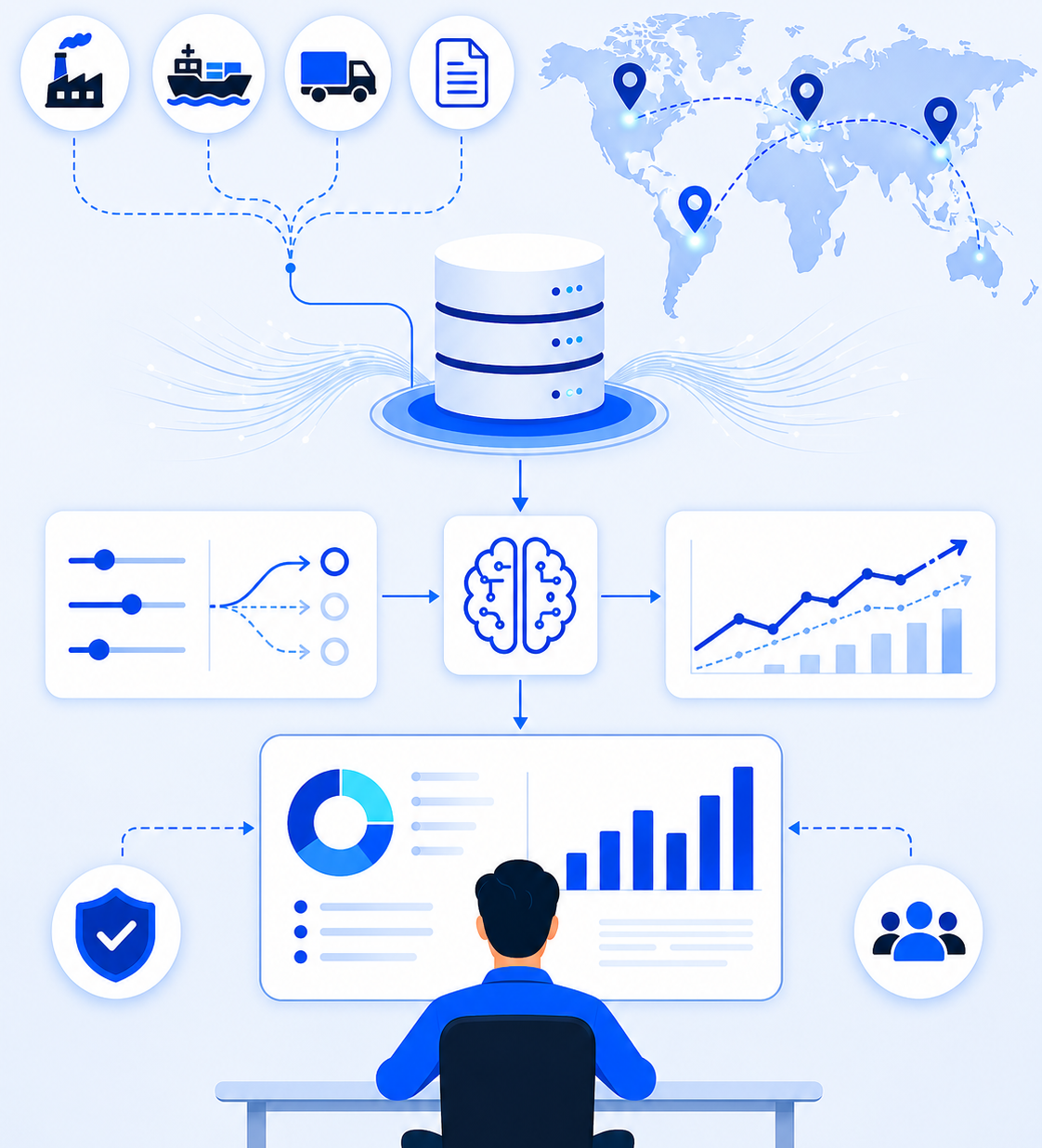
▸Built a unified Common Data Layer, consolidating data from multiple enterprise systems to create a single source of truth for tariff intelligence
▸Developed an advanced What-If Simulation Engine, enabling instant scenario testing across tariff rates, growth factors, and mitigation strategies with high-speed processing
▸Enabled parallel scenario execution with asynchronous processing, allowing multiple simulations to run simultaneously without performance impact
▸Leveraged Databricks + PySpark for large-scale data processing and integrated ARIMA-based forecasting, providing visibility into financial impact up to 36 months ahead
Security & Governance
▸RBAC-based secure access across business units
▸Locking mechanism for safe concurrent processing
▸Automated CI/CD pipelines for smooth deployments
Business Impact
▸Unified data platform eliminating silos
▸Weeks → minutes analysis time
▸Better risk visibility with exposure forecasting
▸Scalable across global markets
Business Impact
▸Unified data platform eliminating silos
▸Weeks → minutes analysis time
▸Better risk visibility with exposure
forecasting
▸Scalable across global markets